


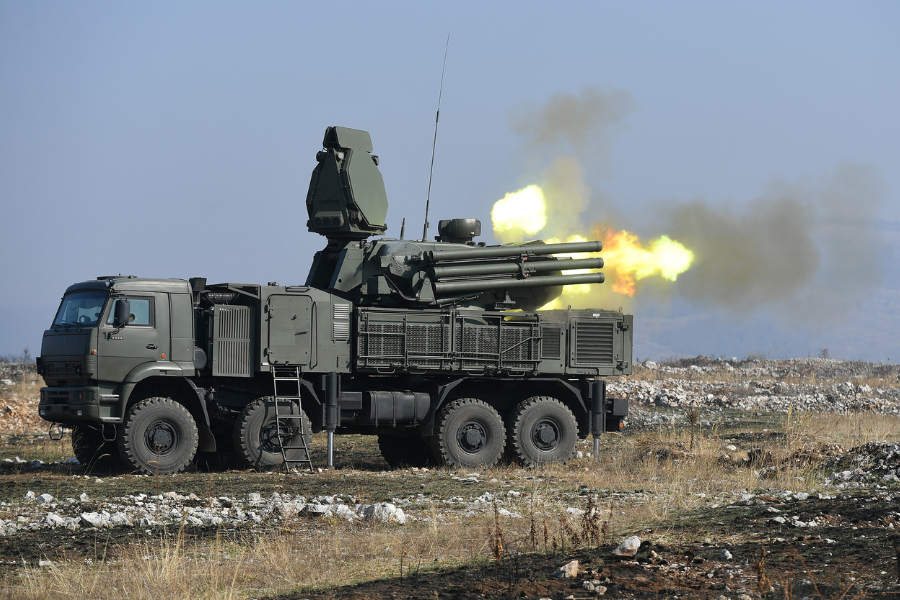
To combat armed and kamikaze drones, the Indian military is thinking about acquiring the Russian Pantsir missile system. Combining the S-400 and Pantsir systems can increase their effectiveness against cross-border aircraft threats.
Let’s first examine the differences between the Pantsir system and the S-400 systems India is purchasing.
The Pantsir-S1M system is intended to succeed the Pantsir-S1 system.
The Pantsir-S1 was created to defend a VA/VP against cruise missiles, enemy aircraft, helicopters, precision weapons, and unmanned aerial vehicles. The S-400, on the other hand, is intended to offer sector defense against missile and aerodynamic threats.
Twelve missiles and two 30 mm guns are carried by the Pantsir system, which has a 20–30 km range. Up to 40 rounds per second can be fired by each gun. Three crew members run the single-vehicle mobile system, which has 1,400 rounds of ammo.
Both a target-acquisition radar and a dual-waveband tracking radar operating in the UHF and EHF channels are part of the Pantsir-S1. An electro-optic channel with an infrared direction finder and a long-wave thermal imager is part of the firing control system.
Compared to the Pantsir-S1, the Pantsir-S1M system has numerous enhancements. It employs a new surface-to-air missile with a stronger 25 kg fragmentation warhead (as opposed to the 20 kg warhead of the regular 57E6-E missile), an engagement range of 20 to 30 km, a ceiling of 15 to 18 km, and a speed of 1,300 to 1,700 m/s. The Pantsir-S1M is equipped with small TKB-1055 “Gvozd” missiles to combat mini-drones, a capability the Pantsir-S1 lacked, in addition to missiles that battle conventional aircraft threats.
The composite body of the TKB-1055 missile is lightweight. The missile is propelled by inertia once its solid-propellant booster is depleted. The missile can hit objects between 500 and 7,000 meters away and between 15 and 5,000 meters above the ground. Four missiles weigh a total of 115 kg. The TKB-1055 missile’s very low cost and widespread production are its most notable features. Thanks to the upgraded phased-array guiding radar, the Pantsir-S1M can supposedly identify a GMLRS missile at twice the range of the S1 model, according to a report published in April 2024 by Russian news agency Sputnik.
It can launch interceptor missiles 1.2 times more quickly. Consequently, 24 GMLRS projectiles fired by two M270 MLRS launchers can now be intercepted by just three Pantsir-SM AD missile systems.
Providing air defense to S-400 missile systems against enemy air strikes using precision munitions, particularly at low to extremely low altitude, is one of the Pantsir-S1M’s key functions.
Remarkably, the IAF did not order Pantsir systems to cover its first five S-400 systems. Even though financial constraints might have played a role, the choice was nonetheless incorrect.
Purchasing fewer S-400 systems would have been more prudent than purchasing them without the protection of the Pantsir system.
To date, the IAF has depended on medium-range missile systems like MR-SAM, which are used to guard S-400 radars and launchers as well as airbases that house S-400 systems. There are two reasons why this kind of planning seems flawed. Firstly, the S-400 is a mobile system. It needs to move along with its air defense protection. The present IAF inventory of medium-range and short-range missile systems cannot protect an S-400 system from coordinated drone and air-to-surface missile strikes. Along with its extended range, layered multi-range missile design, and flexibility to incorporate non-organic (any) air-defense missile systems, the S-400’s greatest strength is its ability to move swiftly.
The S-400 system must be relocated from its peacetime placement at airbases during conflicts. Pakistani military allegedly attacked S-400 launchers at Adampur airbase during Operation Sindoor. But because the IAF had strategically relocated its S-400 batteries, there was no damage. All of the S-400 parts at Adampur that might have been hit were dummies. However, because Pakistan lacked current intelligence, it is significant that the IAF avoided a bullet when Pakistan attacked the S-400 system at Adampur. This might not always be the case.
Russian S-400 systems shielded by Pantsir-S1M systems have shown themselves susceptible to saturation hits by cruise missiles like the Storm Shadow—and, interestingly, to slow-flying drones—during the conflict in Ukraine. Despite the S-400 units’ sporadic relocation, Ukrainian troops have regularly attacked Russian S-400 systems with coordinated drone operations. The capacity of US and NATO aerial ISR assets patrolling over the Black Sea to detect the relocation of Russian S-400 batteries and identify new positions using electronic intelligence (ELINT) is primarily responsible for Ukraine’s success.
Also Read: Red Fort Blast exposes Pakistan’s new terror strategy
In fact, US/NATO ELINT is able to locate Russian S-400 systems as well as identify the Pantsir systems used to defend them. Ukrainian drones can be directed to avoid the Pantsir systems and fly at extremely low altitudes to target Russian S-400 launchers and radars by using real-time data. It is possible that China or the United States will provide Pakistan with comparable intelligence assistance in the future.
It’s likely that India has been attempting to purchase Pantsir systems for some time. Izvestia revealed in August 2020 that a number of foreign nations had indicated interest in acquiring the Pantsir-S1M. Russia’s current special military operation in Ukraine may have caused India’s attempt to purchase the equipment to fail. According to reports from April 2024, Russia plans to treble the number of Pantsir AD missile systems it provides to its armed services. Russia may now be able to ship spare systems to India thanks to increased production. According to reports, India and Russia signed a Memorandum of Understanding (MoU) in November 2024 to work together on creating and perhaps manufacturing customized versions of the technology.